

Thermaco Grease Traps Blog

Monday, March 24, 2008

Effluent Grease Recovery – 21st Century Recyclable Product

Our great grandparents recycled meat drippings into soap. Today their great grandchildren recycle meat drippings and waste cooking oil into biodiesel, cosmetics, animal food additives and hundreds of other useful products. Included in the recycling equation are new systems for capturing and recycling kitchen drain water fats and oils.

The past forty years has seen the rapid rise of the restaurant industry. The proliferation of restaurants throughout towns has also created a serious problem: sewer line clogs caused by grease. Wichita, Kansas, a city of 350,000 population found 85% of their sewer line problems were caused by grease accumulation in the piping. As most food service facility managers already know, grease build-up within a building’s plumbing drainage system is also a major cause of sanitation problems. Effluent grease jeopardizes normal operations as well as creating health and safety hazards within the facility.

Increasingly, sewer districts are implementing programs involving financial penalties to make commercial kitchen operators conform to community standards. Grease separators are now being required and documented servicing is being enforced. Existing restaurants have difficulty retrofitting grease separators because of space, plumbing complexity and construction cost issues. Fortunately, there are newer technology products available to economically enable older facilities to meet community code standards. These new products fit into two categories: 1) automatic grease removal units and 2) compact supercapacity grease interceptors.

Automatic Grease Removal Units (GRDs)
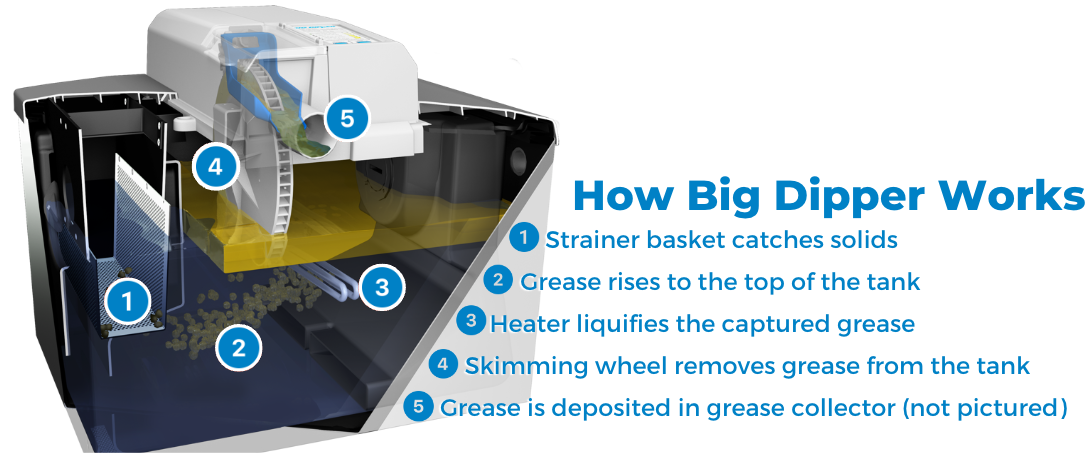
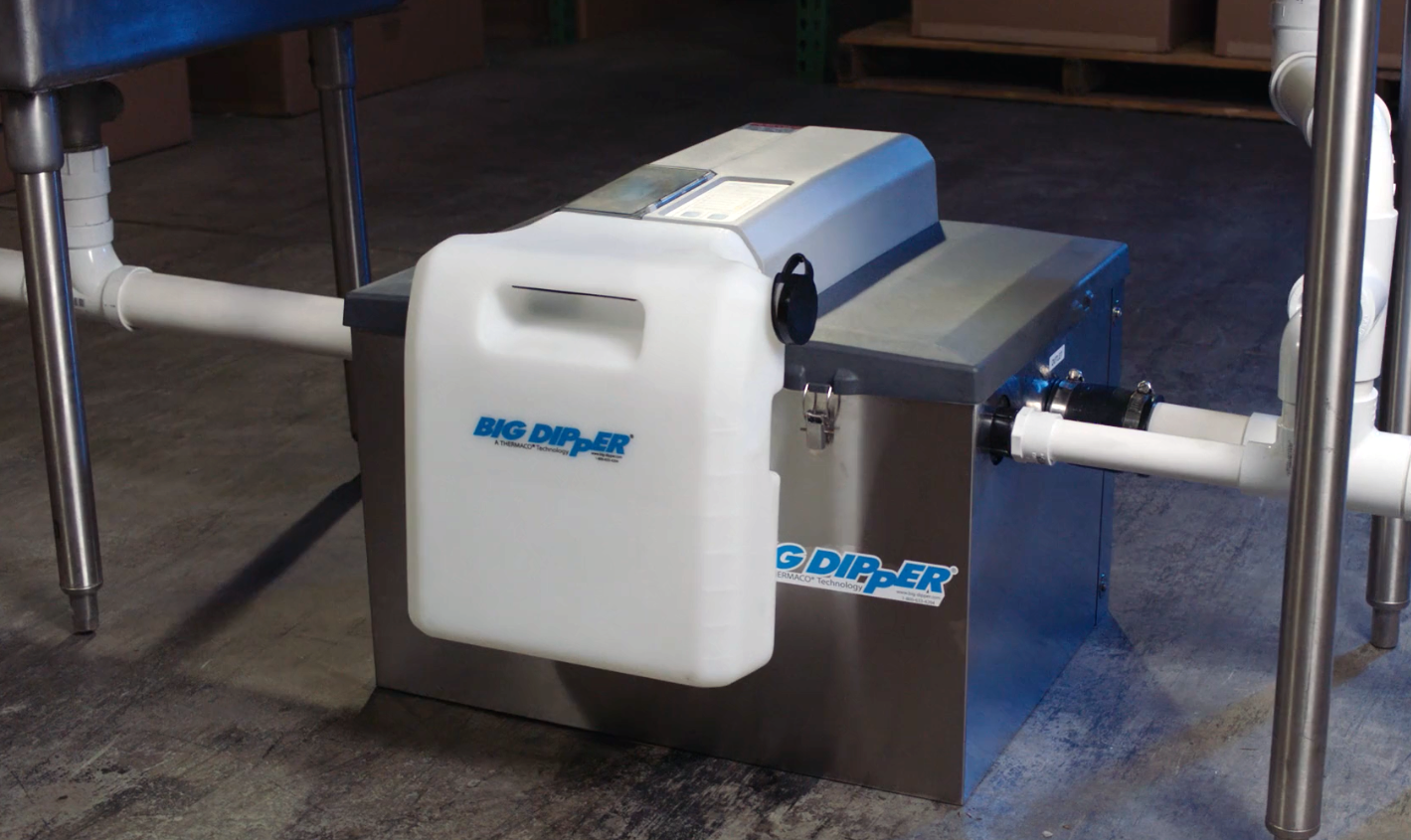
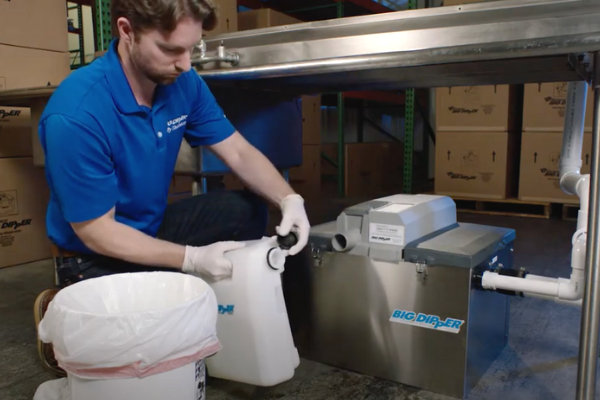
These units are specifically engineered for the separation and removal of free-floating (non-emulsified) grease and oils from kitchen drain water flows. Most units are designed to fit beside pot-washing and dishwashing sinks to capture grease. These units are electrically powered and have a skimming and heating mechanism for daily removal of the captured fats and oils. For example, in a high volume hamburger restaurant, the removal of 7 to 10 pounds (3.2 to 4.6 kg) of grease by an automatic grease removal unit servicing the three- compartment pot-washing sink is typical. Because it is removed on a daily basis, the recovered grease is fresh, water-free and is suitable for recycling into biodiesel and cosmetic products. The grease is kept out of the facility’s piping, reducing maintenance costs and preventing costly downstream blockages.

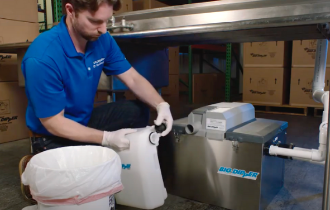
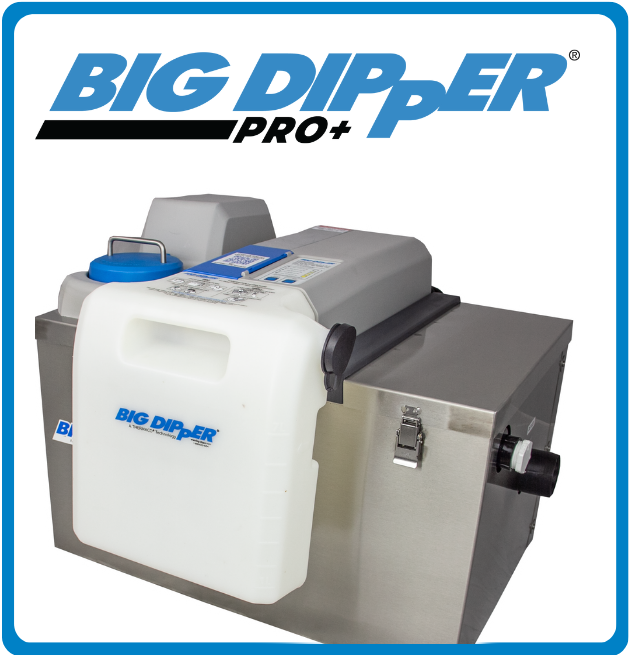
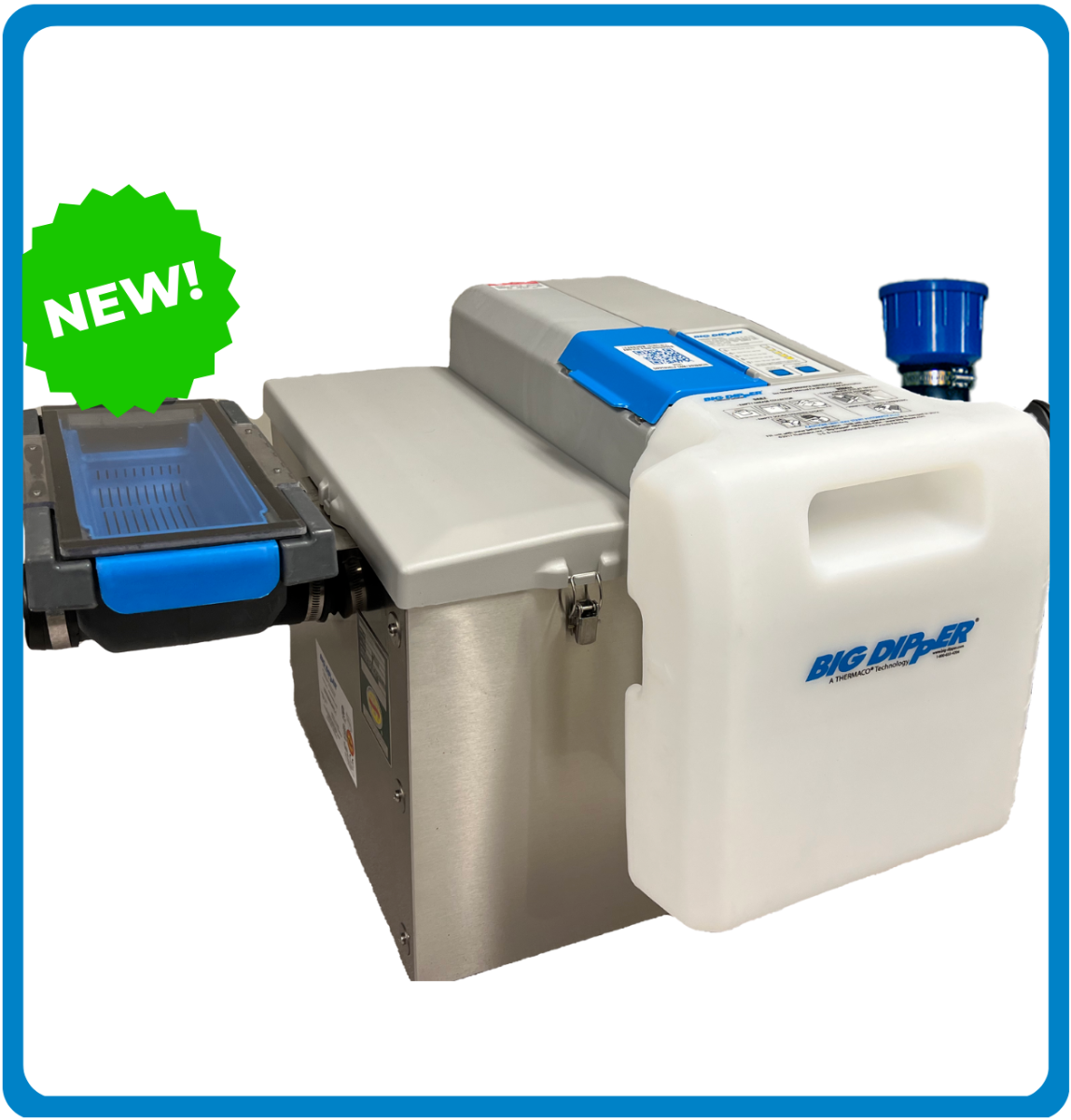
Automatic GRDs offer the simplest installation and lowest operation costs with the restaurant staff routinely emptying the grease container and solids strainer basket. Annual electricity cost is usually less than $25.00. Automatic GRDs cost more than non-automatic grease traps, but pay for themselves in one to four years with lower maintenance and servicing costs. Additionally, many Automatic GRDs like the popular Big Dipper® have sanitary stainless steel and polymer construction which, can last three to four times longer than painted steel grease traps that eventually rust out and are prone to unsanitary stains.

Automatic GRDs are particularly suited to servicing very high grease effluent output cooking appliances like wok ranges, rotisserie ovens and combi-ovens. A high volume rotisserie oven may discharge 15 gallons (57 liters) of water and chicken drippings in one day. Typically, this liquid is 70% fat which means 10.5 gallons (40 liters) of pure fat can be profitably recovered while also saving the facility’s and the city’s piping from congealed grease. In these applications, an Automatic GRD may pay for itself in less than 6 months.

Compact Supercapacity Grease Interceptors (CSGIs)
Many sites have trench and other floor drain receptacles receiving flows from tilt kettles and other grease discharging appliances. There are other sites that do not generate much grease such as ice cream shops, downtown grills and sandwich shops but are required to have high capacity grease separators to protect the city’s sewer piping. With available space being a serious constraint, compact supercapacity grease interceptors are increasingly being installed in these sites. Supercapacity grease interceptors such as the Trapzilla® feature corrosion-resistant polymer construction and are small enough to be carried by two men through a commercial width doorway but large enough to hold 150 kg to 275 kg of retained grease. These supercapacity grease separators have evolved into product lines having solid separator modules, engineered designs that can be mounted between floors and site adaptable extension collars.

Recycling Pays in the 21st Century
The recovered grease from one high volume supermarket rotisserie oven may recover $7500/year in biodiesel grade fats. The recovered grease from a high volume hamburger restaurant’s pot washing sink may be worth $750/year and another $1200/year in avoided facility maintenance costs. With petroleum costs soaring above $100/barrel and predicted to reach $200/barrel in seven years (2015), capturing effluent grease becomes a profitable enterprise. Like our great grandparents, we, too, recycle waste grease for worthwhile products.

Labels: , ,

Wednesday, November 7, 2007

Grease Traps Helping Green the World

In the 1980s, the grease removed from restaurant grease traps, including automatic grease removal systems like Big Dipper® , sometimes was disposed into dumpster trash. At the time, many food service locations did not access to grease recycling services and dumped waste fryer grease, meat drippings and interior grease traps into their garbage waste. Today, nearly all food service establishments are serviced by recycling companies that collect spent fryer grease, meat drippings and grease trap waste. What led to this change? Answer: 1) Recycling restaurant grease waste into consumer products is now profitable and, 2) a network of grease trap pumping services sprang up to service the thousands of in-ground concrete grease separators installed during 1980- 2005 as a result of stricter sewer district requirements for new restaurant construction.

In 1985 there was virtually no biodiesel fuel production. Restaurant grease materials were used in cosmetic, soap and animal feed production with only the purest yellow fat materials acceptable for these uses. Grease trap fats had no recycling value. Furthermore, there was not enough consumption of yellow grease alone to justify higher profit margins. In the intervening years fats and oils consumption in consumer goods, including cosmetics, lotions, dog & cat feeds, cow & chicken feeds, as chemical feed stocks and biodiesel, has led to consumption driving higher prices which, in turn, has made recycling service companies financially healthy. Today’s better recycling economics enable nearly every food service establishment to have on-site yellow grease recycle bins and economically priced grease trap servicing by pumpers who increasingly take the brown grease trap waste to recycling centers.

Let’s define the terms yellow” grease and “brown” grease. Yellow grease is spent cooking oils from fryers, the meat drippings from cooking or left over butter or salad oil. Yellow grease has not come in contact with water but may have entrained solids such as breading, bits of food or other food related particles. Brown grease is fats and oils that come in contact with water such as grease trap waste. Rotisserie grease may be classified as either yellow grease or brown grease depending if the oven uses a water-filled grease collection pan. The same is true for wok ranges, combi-ovens, wet-type ventilation hoods and other kitchen appliances where grease and water mixes are created.

Higher fuel prices have made biodiesel an attractive energy alternative leading to numerous small and medium sized companies entering the biodiesel production business. The increased demand for fats and oils has made brown grease valuable. In addition to being convertible into biodiesel, brown grease is also being utilized to combust one state’s sewer sludge. Connecticut utilized the brown grease in over 7 million gallons of grease trap waste in its sludge incinerators. This “free” fuel enabled environmentally safe disposal of both municipal sludge and grease trap wastes.

Yes, grease traps have always protected the world’s sewer systems by catching food service establishment fats and oils. In today’s energy tight economy, grease traps also provide clean recycled energy source material for biodiesel fuel. Brown grease is now “Green”.

Labels: , , , , ,

Thursday, November 1, 2007

How We Came To Understand Thermal Inversion

Thermaco accidentally stumbled into an answer for grease trap thermal inversion. and, at the time, did not know it. In mid-2003 we were working on developing high capacity/small footprint grease separators capable of meeting the ASME A112.14.3 Standard. This is the separation efficiency and retention capacity certification standard for passive (non-automatic) grease separators. At the time, we were sending production product off to a third party testing laboratory and were failing to hold sufficient capacity to meet the Standard’s retention capacity requirement. This was particularly disconcerting because the products submitted had previously passed the test ten years earlier (the PDI-G101 test which is the predecessor test the ASME A112.14.3 Standard is based upon). Alas, we had no choice but to go to the drawing board and develop a new product design that would meet the A112.14.3 Standard.

To make a long story short, we evaluated numerous product designs and ultimately plowed new ground in the field of grease separator design. We went with a larger traditional design for our Big Dipper product and ultimately passed the test. I say ultimately as this will be covered at the end of this blog story. However, during 18 months of non-stop R & D testing work, we discovered a wholly new design that consistently retained more than twice as much grease and had a significantly flatter separation efficiency curve than our standard separator design. As this new design was unorthodox looking and did not integrate well with an internal strainer, we initially developed a semi-automatic sensor monitored concept called the Klearly™ with automatic solids transfer section. We went on to have this design third-party tested on the ASME A112.14.3 and PDI-G101 tests and discovered it held TWICE as much retained grease as our same size Big Dipper model with conventional separator baffling design. However, the Klearly’s unique product concept was expensive to manufacture and was never commercialized. Inside Thermaco we called this unique separator baffling design the AFI - Automatic Flows Interceptor, but with the decision to walk away from the semi-automatic sensor controlled unit, AFI was just another interesting, patent-pending design concept at Thermaco with no clear application use.

A few months later I was in California at a CalFOG meeting, a consortium of industry folks comprised mainly of sewer district pretreatment managers focusing on implementing effective programs to significantly reduce sewer system grease clog events (SSOs = Sanitary Sewer Overflows). The Pretreatment Managers went around the room discussing things their districts had done which had worked well at controlling food service facility effluent grease discharges to their sewer systems. Nearly all mentioned they had implemented installation of large, in-ground grease separators of 1000 gallon or larger capacity. When it came the turn of the Pretreatment Manager from San Francisco to speak, he painfully stated he did not have the larger in-ground 1000-gallon grease separator option. San Francisco, he explained, was laid out during 1850 - 1910, before the modern era and consequently, most food service facilities have no available space for 1000-gallon grease separators. He went on to say sewer grease clogging was a major problem, particularly in Chinatown, a restaurant intensive zone in one of the city’s oldest developed areas.

His comment triggered a thought. “What if we could take our new separator technology and make a super capacity passive grease trap which could fit through doorways and be installed inside restaurants in Chinatown?” A city with a problem seeking a solution and a company with solution seeking a problem was the genesis of Thermaco’s Trapzilla® product line, products designed for space constrained urban sites to replace smaller conventional grease traps and to provide sufficient capacity for convenient scheduled monthly pumping servicing.

What is interesting is Thermaco had a product design that retained 2X (we now have products that hold up to 3X) as same footprint size conventional grease separators, but we thought our design accomplished this because of superior lower tank flow dynamics control. It took a random telephone conversation to provide the true answer to why our design worked so well. Truthfully, we did not peg thermal inversion as being the causative factor until having a conversation in December 2005 with Stan Steinbach of EEC (Environmental Engineering & Contracting in Santa Ana, California - a recognized leader in researching and developing SSO management programs for Sewer Districts across the USA). Stan remarked our testing phenomena sounded a lot like thermal inversion and that he had recently heard an interesting presentation at WEFTEC (Water Environment Federation’s Technical Exhibition & Conference) by a speaker from WSSC (Washington Suburban Sanitary Commission) regarding separator grease loss caused by thermal inversion. Voila, the light came on and we suddenly understood why our new design works so well! Before hearing of thermal inversion, we thought our grease retention design improvements were primarily caused by better flow dynamics, i.e. reduced roiling motion inside the separator.

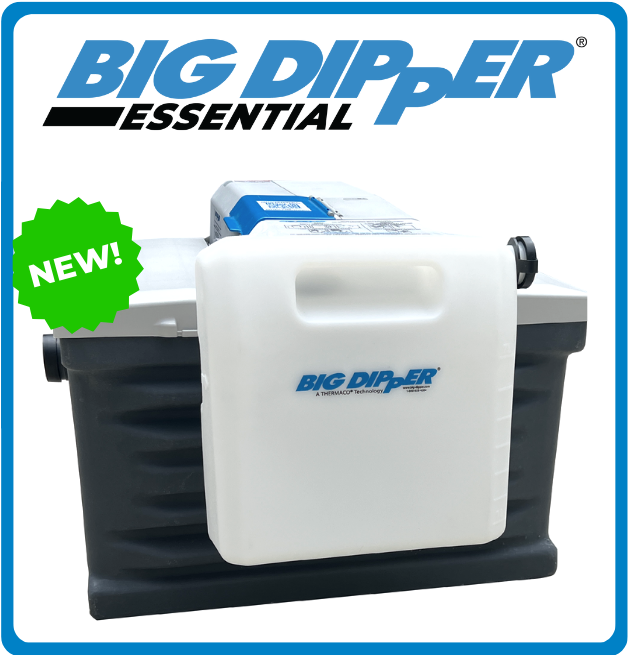
By concentrating on thermal inversion aspects, coupled with flow dynamic aspects (inlet & outlet weir design), we have discovered significant retention efficiencies can be obtained by designing to preclude thermal inversion effects. We now have separator designs that hold as much as 3X the capacity in the same footprint as conventional separators without affecting separation efficiency. Our Trapzilla® product line is based on AFI thermal inversion technology. Our soon to be introduced compact Big Dipper® line is also based on AFI thermal inversion technology, too. Although these products do not resemble each other in the least, they are indeed utilizing proprietary AFI design technology.

Back to the story beginning, we later discovered the third-party laboratory ASME testing apparatus was not built correctly to the A112.14.3 standard. Had it been built correctly, it is likely the original Big Dipper units would have passed the test and thus, the new AFI technology would not have been discovered. Trapzilla, the new compact Big Dipper series and the present center-module style Big Dipper platform would never have been produced. As the adage goes, “Necessity is the Mother of Invention” and our initial difficulties eventually led to new and much needed answers for sewer districts around the world.

Labels: